

01 / Before the boom
The ring arrives before the culture does.
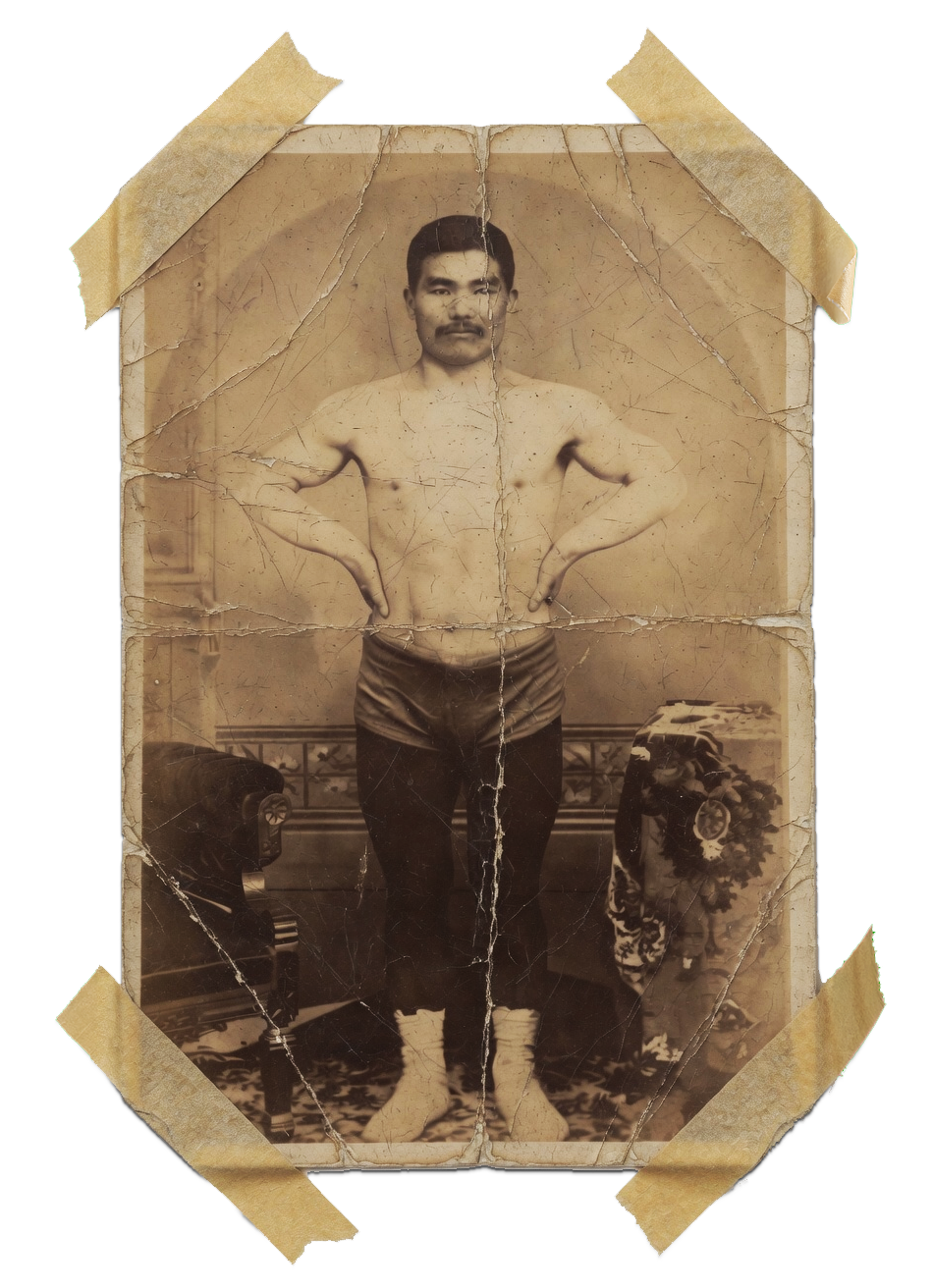
The first bridge into Japanese professional wrestling was not a promotion or a television star. It was Matsuda Sorakichi, a former sumo wrestler who left Japan for the United States in the early 1880s, worked American wrestling circuits, and returned to test whether Western-style wrestling could draw a Japanese audience.
In 1887, Matsuda and fellow former rikishi Hamada Shokichi staged an exhibition in Ginza. It did not create a lasting boom, but it matters because it shows the pattern that would repeat later: imported wrestling had to be translated into a form Japanese audiences could claim as their own.
- Recorded exhibition1887
- PlaceGinza, Tokyo
- ParticipantsMatsuda Sorakichi and Hamada Shokichi
02 / The broadcast hero
Television turns wrestling into a public ritual.
Rikidozan made modern puroresu possible by giving imported wrestling a Japanese emotional frame. A former sumo wrestler, he debuted in professional wrestling in 1951 and founded the Japan Pro Wrestling Alliance in 1953, creating the first durable promotional center for the postwar boom.
By 1954, crowds were gathering around public television sets to watch his matches against foreign opponents. Television turned wrestling into a shared event, and Rikidozan's karate chop gave viewers a clear heroic language to follow.
- Pro debut1951
- Promotion foundedJapan Pro Wrestling Alliance, 1953
- Broadcast breakthroughPublic TV crowds documented by 1954

03 / The inheritance splits
One foundation becomes two futures.
Giant Baba and Antonio Inoki entered Rikidozan's JWA system together and debuted on the same Tokyo card on September 30, 1960. Baba came from professional baseball; Inoki had been recruited after Rikidozan encountered him in Brazil. Their shared start is why the later split matters: the two major visions of puroresu grew from the same training root.
After Rikidozan's death in 1963 and the decline of the JWA center, Inoki founded New Japan on January 13, 1972. Baba's All Japan opened with its first card on October 21, 1972. From there, the timeline becomes easier to read as two answers to the same question: should wrestling prove legitimacy through confrontation, or build drama through hierarchy, patience, and accumulated history?
- Shared debutSeptember 30, 1960
- New Japan establishedJanuary 13, 1972
- All Japan first cardOctober 21, 1972

04 / The styles separate
Puroresu develops different languages.
By the 1980s, the Baba-Inoki split had become several distinct wrestling languages. New Japan carried Inoki's legitimacy project while Tiger Mask's 1981 debut against Dynamite Kid changed what junior-heavyweight wrestling could look like. All Japan's heavyweight line moved toward King's Road through Jumbo Tsuruta, Genichiro Tenryu, foreign power opponents, and long-term title consequence.
Inoki's 1976 draw with Muhammad Ali became a legitimacy anchor; the original UWF's first card followed in Omiya on April 11, 1984.
All Japan's annual tag league began in 1977, while Jumbo, Tenryu, Hansen, Brody, and later Misawa made accumulated damage matter.
Tiger Mask debuted on April 23, 1981 against Dynamite Kid, making speed, counters, and aerial precision central rather than decorative.
The Crush Gals formed around 1983 in AJW's Fuji TV era, where Chigusa Nagayo and Lioness Asuka connected athletic style to pop culture.
- Tiger Mask debutApril 23, 1981
- Original UWF first cardApril 11, 1984
- Crush Gals anchorJanuary 4, 1983


05 / The 1990s peak
Each branch becomes a world.
In the 1990s, the branches became full worlds. Misawa removing the Tiger Mask on May 14, 1990 and pinning Jumbo Tsuruta at Budokan on June 8 turned All Japan's generational conflict into the Four Pillars era. New Japan's 1984 dojo class became the Three Musketeers, with the 1991 G1 Climax final placing Chono and Mutoh at the center of the promotion's next heavyweight story.
At the same time, Dream Slam showed joshi's interpromotional scale, FMW escalated deathmatch spectacle through Onita's exploding-ring main events, and the Super J-Cup made junior-heavyweight wrestling legible as an international network. The scenes were different, but they shared one lesson for the Timeline: each promotion built meaning by asking viewers to remember what came before.
- Misawa pins TsurutaJune 8, 1990, Nippon Budokan
- Dream SlamApril 2, 1993, Yokohama Arena
- Super J-CupApril 16, 1994, Ryogoku Kokugikan


06 / The open archive
The archive opens wider.
The 2000s fractured the old map: All Japan's roster exodus led to Pro Wrestling NOAH, FMW collapsed, and New Japan's Inokiism years narrowed the audience. The recovery did not come from one place. It came through new stars, new ownership structures, and eventually direct digital access.
NJPW World launched on December 1, 2014, changing discovery from tape-trading and isolated uploads into live and on-demand access. Okada's January 4, 2017 Tokyo Dome defense against Kenny Omega became a streaming-era gateway match, while Bushiroad's 2019 purchase of Stardom expanded the modern joshi stage. This is where the full Timeline takes over: revival, global access, succession, and the archive becoming easier to enter without losing its history.
- NJPW World launchDecember 1, 2014
- Okada vs Omega gatewayJanuary 4, 2017, Tokyo Dome
- Bushiroad buys StardomAnnounced October 17, 2019


